Overview of Partitions
Partitioning enables you to decompose very large tables and indexes into smaller and more manageable pieces called partitions. Each partition is an independent object with its own name and optionally its own storage characteristics.
分区能将大的表或索引划分为更小的部分以便管理,每个分区都有自己的分区名,有它自己的存储特点。
From the perspective of an application, only one schema object exists. DML statements require no modification to access partitioned tables. Partitioning is useful for many different types of database applications, particularly those that manage large volumes of data. Benefits include:
Increased availability
The unavailability of a partition does not entail the unavailability of the object. The query optimizer automatically removes unreferenced partitions from the query plan so queries are not affected when the partitions are unavailable.
Easier administration of schema objects
A partitioned object has pieces that can be managed either collectively or individually. DDL statements can manipulate partitions rather than entire tables or indexes. Thus, you can break up resource-intensive tasks such as rebuilding an index or table. For example, you can move one table partition at a time. If a problem occurs, then only the partition move must be redone, not the table move. Also, dropping a partition avoids executing numerous DELETE statements.
Reduced contention for shared resources in OLTP systems
In some OLTP systems, partitions can decrease contention for a shared resource. For example, DML is distributed over many segments rather than one segment.
Enhanced query performance in data warehouses
In a data warehouse, partitioning can speed processing of ad hoc queries. For example, a sales table containing a million rows can be partitioned by quarter.
Local Partitioned Indexes
In a local partitioned index, the index is partitioned on the same columns, with the same number of partitions and the same partition bounds as its table. Each index partition is associated with exactly one partition of the underlying table, so that all keys in an index partition refer only to rows stored in a single table partition. In this way, the database automatically synchronizes index partitions with their associated table partitions, making each table-index pair independent.
Local partitioned indexes are common in data warehousing environments. Local indexes offer the following advantages:
Availability is increased because actions that make data invalid or unavailable in a partition affect this partition only.
Partition maintenance is simplified. When moving a table partition, or when data ages out of a partition, only the associated local index partition must be rebuilt or maintained. In a global index, all index partitions must be rebuilt or maintained.
If point-in-time recovery of a partition occurs, then the indexes can be recovered to the recovery time (see "Data File Recovery"). The entire index does not need to be rebuilt.
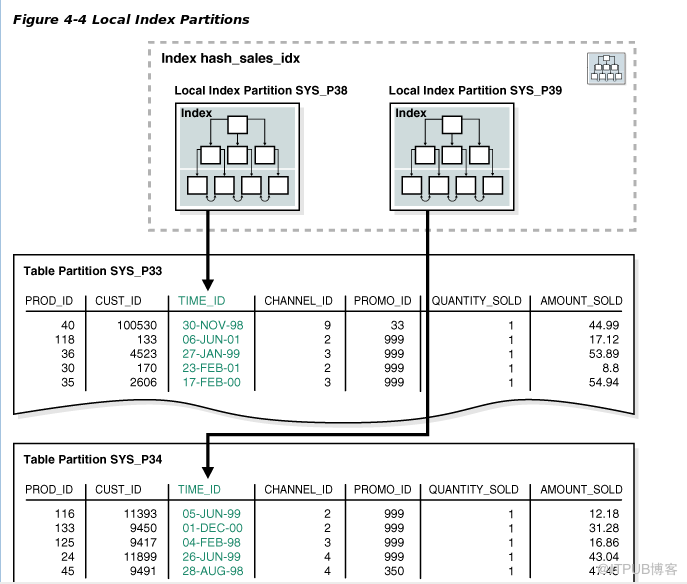
CREATE INDEX hash_sales_idx ON hash_sales(time_id) LOCAL;
Global Partitioned Indexes
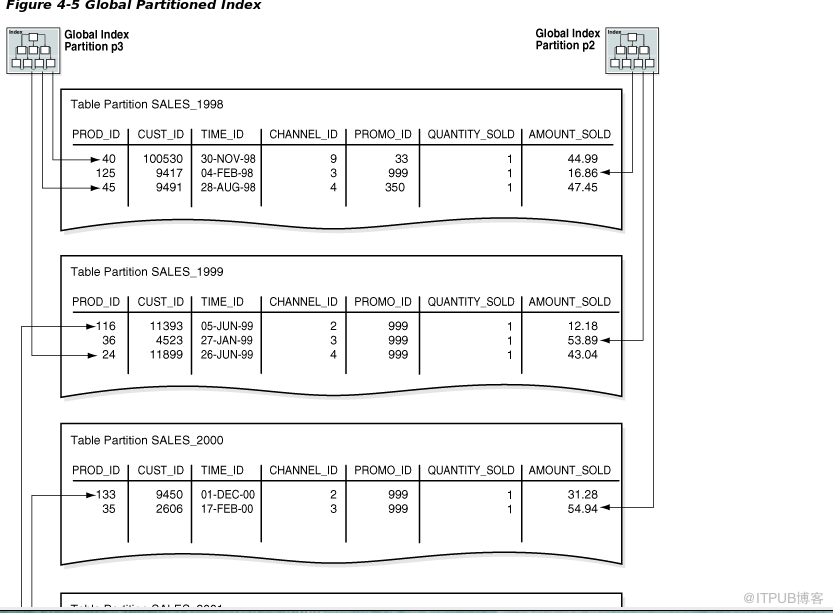
A global partitioned index is a B-tree index that is partitioned independently of the underlying table on which it is created. A single index partition can point to any or all table partitions, whereas in a locally partitioned index, a one-to-one parity exists between index partitions and table partitions.
In general, global indexes are useful for OLTP applications, where rapid access, data integrity, and availability are important. In an OLTP system, a table may be partitioned by one key, for example, the employees.department_id column, but an application may need to access the data with many different keys, for example, by employee_id or job_id. Global indexes can be useful in this scenario.
You can partition a global index by range or by hash. If partitioned by range, then the database partitions the global index on the ranges of values from the table columns you specify in the column list. If partitioned by hash, then the database assigns rows to the partitions using a hash function on values in the partitioning key columns.
Example Global Partitioned Index
CREATE INDEX time_channel_sales_idx ON time_range_sales (channel_id)
GLOBAL PARTITION BY RANGE (channel_id)
(PARTITION p1 VALUES LESS THAN (3),
PARTITION p2 VALUES LESS THAN (4),
PARTITION p3 VALUES LESS THAN (MAXVALUE));
Partitioned Index-Organized Tables
You can partition an index-organized table (IOT) by range, list, or hash. Partitioning is useful for providing improved manageability, availability, and performance for IOTs. In addition, data cartridges that use IOTs can take advantage of the ability to partition their stored data.
Note the following characteristics of partitioned IOTs:
Partition columns must be a subset of primary key columns.
Secondary indexes can be partitioned locally and globally.
OVERFLOW data segments are always equipartitioned with the table partitions.
Oracle Database supports bitmap indexes on partitioned and nonpartitioned index-organized tables. A mapping table is required for creating bitmap indexes on an index-organized table.