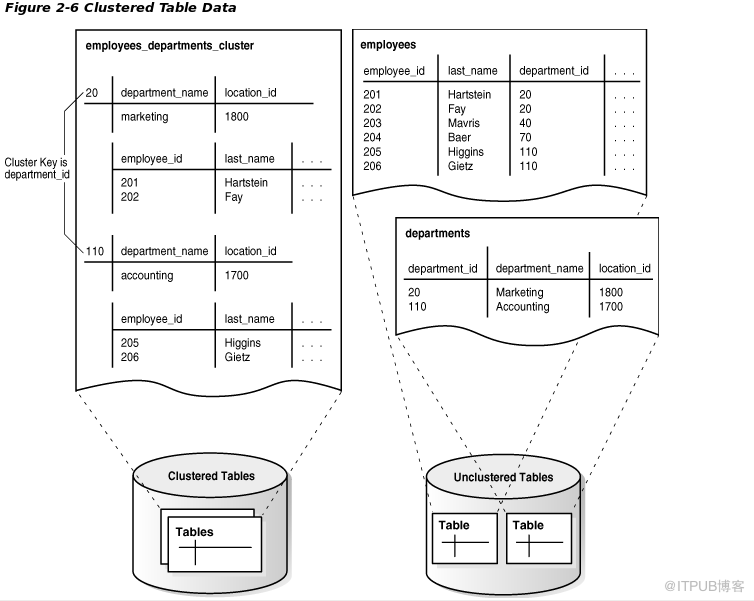
A table cluster is a group of tables that share common columns and store related data in the same blocks. When tables are clustered, a single data block can contain rows from multiple tables. For example, a block can store rows from both the employees and departments tables rather than from only a single table.
聚簇表是一组有着共同的列和存储相关的数据在相同的块中的表。
The cluster key is the column or columns that the clustered tables have in common. For example, the employees and departments tables share the department_id column. You specify the cluster key when creating the table cluster and when creating every table added to the table cluster.
聚簇键是指那些在聚簇表有共同的列。
The cluster key value is the value of the cluster key columns for a particular set of rows. All data that contains the same cluster key value, such as department_id=20, is physically stored together. Each cluster key value is stored only once in the cluster and the cluster index, no matter how many rows of different tables contain the value.
每个聚簇键值只在聚簇和索引聚簇中存储一次。
For an analogy, suppose an HR manager has two book cases: one with boxes of employees folders and the other with boxes of departments folders. Users often ask for the folders for all employees in a particular department. To make retrieval easier, the manager rearranges all the boxes in a single book case. She divides the boxes by department ID. Thus, all folders for employees in department 20 and the folder for department 20 itself are in one box; the folders for employees in department 100 and the folder for department 100 are in a different box, and so on.
You can consider clustering tables when they are primarily queried (but not modified) and records from the tables are frequently queried together or joined. Because table clusters store related rows of different tables in the same data blocks, properly used table clusters offer the following benefits over nonclustered tables:
1.Disk I/O is reduced for joins of clustered tables.
2. time improves for joins of clustered tables.
3.Less storage is required to store related table and index data because the cluster key value is not stored repeatedly for each row.
Typically, clustering tables is not appropriate in the following situations:
1.The tables are frequently updated.
2.The tables frequently require a full table scan.
3.The tables require truncating.
A table cluster is a group of one or more tables that are physically stored together because they share common columns and usually appear together in SQL statements. Because the database physically stores related rows together, disk access time improves. To create a cluster, use the CREATE CLUSTER statement.
1.Follow these guidelines when deciding whether to cluster tables:
1.Cluster tables that are accessed frequently by the application in join statements.
2.Do not cluster tables if the application joins them only occasionally or modifies their common column values frequently. Modifying a row's cluster key value takes longer than modifying the value in an unclustered table, because Oracle Database might need to migrate the modified row to another block to maintain the cluster.
如果应用只是偶尔join或着频繁的修改相同的列值的话,建议不使用CLUSTER TABLES。修改一行聚簇键值花费远比非聚簇表多,因为数据库可能需要迁移被修改的行到另外的块去来维护聚簇。
3.Do not cluster tables if the application often performs full table scans of only one of the tables. A full table scan of a clustered table can take longer than a full table scan of an unclustered table. Oracle Database is likely to read more blocks because the tables are stored together.
不要在应用经常使用full table scan下使用cluster table,因为oracle 数据库可能读更多的块。
4.Cluster master-detail tables if you often select a master record and then the corresponding detail records. Detail records are stored in the same data block(s) as the master record, so they are likely still to be in memory when you select them, requiring Oracle Database to perform less I/O.
5. Store a detail table alone in a cluster if you often select many detail records of the same master. This measure improves the performance of queries that select detail records of the same master, but does not decrease the performance of a full table scan on the master table. An alternative is to use an index organized table.
6. Do not cluster tables if the data from all tables with the same cluster key value exceeds more than one or two data blocks. To access a row in a clustered table, Oracle Database reads all blocks containing rows with that value. If these rows take up multiple blocks, then accessing a single row could require more reads than accessing the same row in an unclustered table.
如果具有相同簇键值的所有表的数据超过一个或两个以上的数据块,不要使用聚簇表。因为如果这些行在多个块中,需要更多的读取相对于非聚簇表中中的一行而言。
7.Do not cluster tables when the number of rows for each cluster key value varies significantly. This causes waste of space for the low cardinality key value; it causes collisions for the high cardinality key values. Collisions degrade performance.
当每个簇键值的行数变化显着。这会导致浪费空间的低基数键值,它会导致高基数键值的碰撞。碰撞会降低性能。
Consider the benefits and drawbacks of clusters for the application. For example, you might decide that the performance gain for join statements outweighs the performance loss for statements that modify cluster key values. You might want to experiment and compare processing times with the tables both clustered and stored separately.
2.Creating a Cluster
To create a cluster in your schema, you must have the CREATE CLUSTER system privilege and a quota for the tablespace intended to contain the cluster or the UNLIMITED TABLESPACE system privilege.
To create a cluster in another user's schema you must have the CREATE ANY CLUSTER system privilege, and the owner must have a quota for the tablespace intended to contain the cluster or the UNLIMITED TABLESPACE system privilege.
You create a cluster using the CREATE CLUSTER statement. The following statement creates a cluster named emp_dept, which stores the emp and dept tables, clustered by the deptno column:
CREATE CLUSTER emp_dept (deptno NUMBER(3))
SIZE 600
TABLESPACE users
STORAGE (INITIAL 200K
NEXT 300K
MINEXTENTS 2
PCTINCREASE 33);
If no INDEX keyword is specified, as is true in this example, an index cluster is created by default. You can also create a HASH cluster, when hash parameters (HASHKEYS, HASH IS, or SINGLE TABLE HASHKEYS) are specified.
3.Creating Clustered Tables
To create a table in a cluster, you must have either the CREATE TABLE or CREATE ANY TABLE system privilege. You do not need a tablespace quota or the UNLIMITED TABLESPACE system privilege to create a table in a cluster.
You create a table in a cluster using the CREATE TABLE statement with the CLUSTER clause. The emp and dept tables can be created in the emp_dept cluster using the following statements:
CREATE TABLE emp (
empno NUMBER(5) PRIMARY KEY,
ename VARCHAR2(15) NOT NULL,
. . .
deptno NUMBER(3) REFERENCES dept)
CLUSTER emp_dept (deptno);
CREATE TABLE dept (
deptno NUMBER(3) PRIMARY KEY, . . . )
CLUSTER emp_dept (deptno);
Note:
You can specify the schema for a clustered table in the CREATE TABLE statement. A clustered table can be in a different schema than the schema containing the cluster. Also, the names of the columns are not required to match, but their structure must match.
详细请参考:
http://docs.oracle.com/cd/E11882_01/server.112/e40540/tablecls.htm#CNCPT88827
http://docs.oracle.com/cd/E11882_01/server.112/e41573/data_acc.htm#PFGRF94791
如有错误,欢迎指正。