1、介绍
在InnoDB启动时,如果是新建数据库则需初始化库,需要创建字典管理的相关信息。函数innobase_start_or_create_for_mysql调用dict_create完成此功能。即创建数据字典,因为InnoDB系统表的个数结构固定,所以初始化库的时候只需要创建这几个表的B+树即可并将B+树的根页号存放到固定位置。对于B+树,只要找到根页面,就可以从根页面开始检索数据。相关系统表(即上一节讲到的4个系统表)在InnoDB内部,不会暴露给用户。
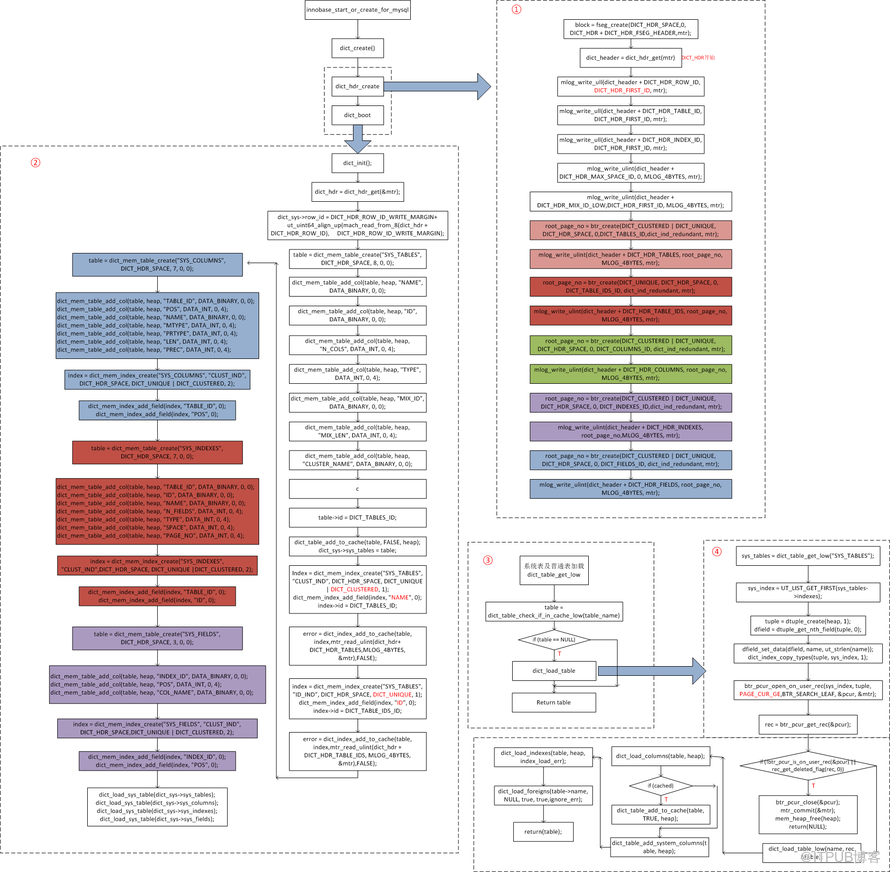
4个系统表通过固定的硬编码进行构建。具体原理流程如下。
2、数据字典创建及加载原理流程
3、说明
1)innobase_start_or_create_for_mysql函数调用dict_create()函数进行数据字典的创建和加载工作。
2)dict_hdr_create完成系统表空间第7号页面dict header的初始化及创建SYS_TABLES两个索引、SYS_COLUMNS一个索引、SYS_INDEXES一个索引、SYS_FIELDS一个索引,其创建索引的函数是btr_create。
3)创建B+树索引后,通过dict_boot函数加载常驻内存的4个系统表。具体流程见流程图的②部分。
4)加载完成后,将这4个系统表挂在一个全局字典中:
dict0dict.h::
点击(此处)折叠或打开
-
/* Dictionary system struct */
-
struct dict_sys_t{
-
ib_mutex_t mutex; /*!< mutex protecting the data
-
dictionary; protects also the
-
disk-based dictionary system tables;
-
this mutex serializes CREATE TABLE
-
and DROP TABLE, as well as reading
-
the dictionary data for a table from
-
system tables */
-
row_id_t row_id; /*!< the next row id to assign;
-
NOTE that at a checkpoint this
-
must be written to the dict system
-
header and flushed to a file; in
-
recovery this must be derived from
-
the log records */
-
hash_table_t* table_hash; /*!< hash table of the tables, based
-
on name */
-
hash_table_t* table_id_hash; /*!< hash table of the tables, based
-
on id */
-
ulint size; /*!< varying space in bytes occupied
-
by the data dictionary table and
-
index objects */
-
dict_table_t* sys_tables; /*!< SYS_TABLES table */
-
dict_table_t* sys_columns; /*!< SYS_COLUMNS table */
-
dict_table_t* sys_indexes; /*!< SYS_INDEXES table */
-
dict_table_t* sys_fields; /*!< SYS_FIELDS table */
-
-
/*=============================*/
-
UT_LIST_BASE_NODE_T(dict_table_t)
-
table_LRU; /*!< List of tables that can be evicted
-
from the cache */
-
UT_LIST_BASE_NODE_T(dict_table_t)
- table_non_LRU; /*!< List of tables that can
结构体中sys_tables、sys_columns、sys_indexes、sys_fields四个结构存储上述对应的4个系统表。
结构体中HASH表及链表用来存储InnoDB中的所有表的缓存,包括系统表及用户表。table_hash哈希表按名字缓存,table_id_hash按表ID进行hash,LRU链表用来管理表对象缓存。
5)普通用户表加载流程见流程图的③、④部分。
当用户访问一个用户表时,首先需要从表对象缓存中查找这个表的SHARE对象,如果找到则直接从其实例化表对象链表中拿一个使用;如果没有找到,则需要重新打开这个表,需要找到这个表的字典信息。即③的流程。
具体加载一个表的字典是④流程,dict_load_table的工作。
a)首先需要找到SYS_TABLES表,也是先找缓存,缓存找不到再从系统表加载: dict_table_get_low
b)找到之后构建一个查询键值,从SYS_TABLES的name主键索引进行查询,如果诶呦找到或者该记录已经被删除则返回,否则解析找到的这条记录。然后根据这些信息创建表的内存对象table。
c)加载列操作与加载表的原理基本一样,对应系统表的SYS_COLUMNS,聚集索引为(TABLE_ID,POS),查找时,如果TABLE_ID相同,在POS从小到大排序,所以构造所有列的键值时,只需要通过TABLE_ID查询即可,按顺序取出所有列信息一一构造内存对象。
d)加载索引信息类似的流程