Partition Improvements in PostgreSQL 13
自从在PostgreSQL 10中引入了声明式分区的语法之后,PostgreSQL中的表分区特性有了很大的进步。PostgreSQL中的分区特性最初是由Simon Rigs在8.1版本中添加的,它基于表继承的概念,并使用约束排除 ( constraint_exclusion) 以在查询过程中排除不需要的继承表。约束排除会基于查询过滤器对表进行剪枝。在引入声明式分区 https://git.postgresql.org/gitweb/?p=postgresql.git;a=commitdiff;h=f0e44751d7175f 之前,意味着我们不得不手动创建子表、约束、触发器等等,这不仅很笨重繁琐还容易出错。十分感谢Amit Langote和其他人的出色工作,PostgreSQL10 引入的声明式分区意味着用户不再需要手动创建分区,也不需要为了将 rows 路由到正确的分区而去创建约束和触发器。之前创建分区所需的所有人工操作都可以通过简单的标准创建分区表的语法来完成,这是往前迈出的一大步,这个特性对用户十分友好。
这篇博客讲述的是PostgreSQL 13对分区表进行了哪些增强。我将在博客中列出所有的增强点,并通过示例演示其中一些特性。
总览
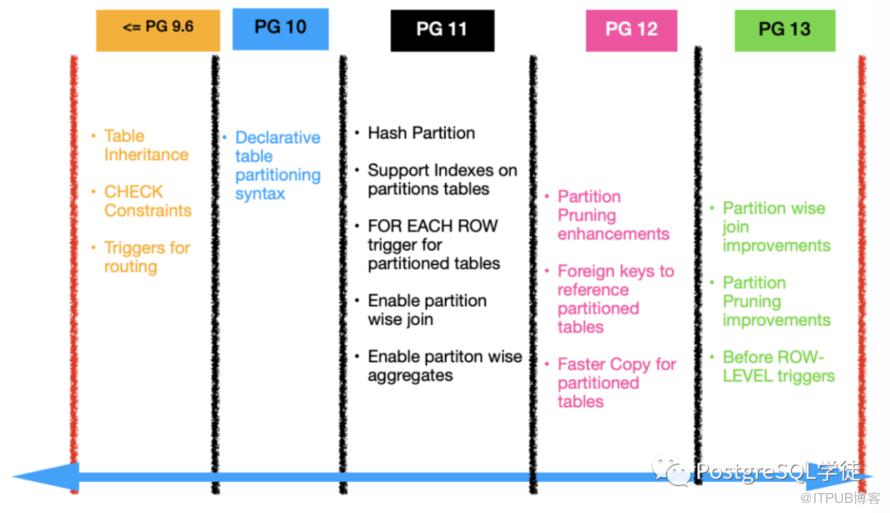
在我们讨论PostgreSQL13所做的分区表增强之前,先快速介绍一下分区和分区特性的时间线。分区是一种将一个大表分割成多个小表的方法,我们可以使用PostgreSQL提供的List、Range或Hash的分区技术对表进行划分。父表自身不存储任何数据,数据存储在创建分区表时所定义的分区中。虽然可以直接访问分区,不过查询通常都是指定逻辑上的父表,并将元组路由到正确的分区以进行插入和更新。在进行查询的情况下,会扫描所需的分区以执行相应的客户端查询。如下是这些年来引进到PostgreSQL中的一些分区特性关键要点:
分区的好处
将一个大表分成几个小表有很多好处,主要的好处如下:
如果执行某个查询只需要访问单个分区或少量分区,而不是查询整个表,那么查询性能可以得到显著的提高。
如果将插入和更新路由到单个分区,那么由于是在单个分区上使用了顺序扫描,而不是在整个表上进行索引或随机扫描,性能也可以得到显著提高。
批量加载和删除可以通过添加或删除分区来完成
当数据在逻辑上被划分为多个小表时,可以很方便得管理大表
如下是PostgreSQL13对分区的特性增强列表 https://www.postgresql.org/docs/13/release-13.html
Improve cases where pruning of partitions can happen (Yuzuko Hosoya, Amit Langote, Álvaro Herrera)
Allow partitionwise joins to happen in more cases (Ashutosh Bapat, Etsuro Fujita, Amit Langote, Tom Lane) – For example, partitionwise joins can now happen between partitioned tables even when their partition bounds do not match exactly.
Allow BEFORE row-level triggers on partitioned tables (Álvaro Herrera) – These triggers cannot change which partition is the destination.
Allow partitioned tables to be logically replicated via publications (Amit Langote)
Allow logical replication into partitioned tables on subscribers (Amit Langote) – Previously, subscribers could only receive rows into non-partitioned tables.
Allow ROW values to be used as partitioning expressions (Amit Langote)
译者著:
可以分区裁剪的case增多
智能分区join增强
支持before trigger(但不允许改变插入数据的目标分区)
之前只能把分区表的各个分区单独做为复制源,现在可以把分区表直接做为复制源。
先前订阅者只能把数据同步到非分区表,现在可以把数据同步到分区表
支持异构分区表逻辑复制: http://www.postgres.cn/v2/news/viewone/1/604
Allow whole-row variables (that is,
table.*) to be used in partitioning expressions (Amit Langote)
现在让我们深入研究上述列表中的这些增强
Improve Partition-wise join to handle more cases
PostgreSQL 11中首次添加了分区智能join的特性,它提供了连接两个分区表的能力,以匹配分区边界。PostgreSQL 13在这一块添加了一些修改以处理更多的情况,比如当分区边界不匹配时。下面是一个演示这种行为的例子
创建分区表并设置enable_partitionwise_join 为 true,这些表会在本博客中演示的所有示例中使用。
postgres=# drop table foo;
DROP TABLE
postgres=# CREATE TABLE foo (x int, y date, z int) PARTITION BY RANGE(y);
CREATE TABLE
postgres=# CREATE TABLE foo_p1 PARTITION OF foo FOR VALUES FROM ('2006-02-01') TO ('2006-03-01');
CREATE TABLE
postgres=# CREATE TABLE foo_p2 PARTITION OF foo FOR VALUES FROM ('2006-03-01') TO ('2006-04-01');
CREATE TABLE
postgres=# CREATE TABLE foo_p3 PARTITION OF foo FOR VALUES FROM ('2006-04-01') TO ('2006-05-01');
CREATE TABLE
postgres=# drop table foo2;
DROP TABLE
postgres=# CREATE TABLE foo2 (x int, y int, z date) PARTITION BY RANGE(z);
CREATE TABLE
postgres=# CREATE TABLE foo2_p1 PARTITION OF foo2 FOR VALUES FROM ('2006-02-01') TO ('2006-03-01');
CREATE TABLE
postgres=# CREATE TABLE foo2_p2 PARTITION OF foo2 FOR VALUES FROM ('2006-03-01') TO ('2006-04-01');
CREATE TABLE
postgres=#
postgres=# set enable_partitionwise_join TO true;
SET
PostgreSQL 12
postgres=# explain (costs off)
postgres-# select * from foo f1, foo2 f2 where f1.y = f2.z and f2.z between ('2006-02-01') and ('2006-05-01');
                                      QUERY PLAN
---------------------------------------------------------------------------------------
 Hash Join
   Hash Cond: (f1.y = f2.z)
   ->  Append
         ->  Seq Scan on foo_p1 f1
         ->  Seq Scan on foo_p2 f1_1
         ->  Seq Scan on foo_p3 f1_2
   ->  Hash
         ->  Append
               ->  Seq Scan on foo2_p1 f2
                     Filter: ((z >= '2006-02-01'::date) AND (z <= '2006-05-01'::date))
               ->  Seq Scan on foo2_p2 f2_1
                     Filter: ((z >= '2006-02-01'::date) AND (z <= '2006-05-01'::date))
(12 rows)
PostgreSQL 13
postgres=# explain (costs off)
postgres-# select * from foo f1, foo2 f2 where f1.y = f2.z and f2.z between ('2006-02-01') and ('2006-05-01');
                                      QUERY PLAN
---------------------------------------------------------------------------------------
 Append
   ->  Hash Join
         Hash Cond: (f1_1.y = f2_1.z)
         ->  Seq Scan on foo_p1 f1_1
         ->  Hash
               ->  Seq Scan on foo2_p1 f2_1
                     Filter: ((z >= '2006-02-01'::date) AND (z <= '2006-05-01'::date))
   ->  Hash Join
         Hash Cond: (f1_2.y = f2_2.z)
         ->  Seq Scan on foo_p2 f1_2
         ->  Hash
               ->  Seq Scan on foo2_p2 f2_2
                     Filter: ((z >= '2006-02-01'::date) AND (z <= '2006-05-01'::date))
(13 rows)
译者著:
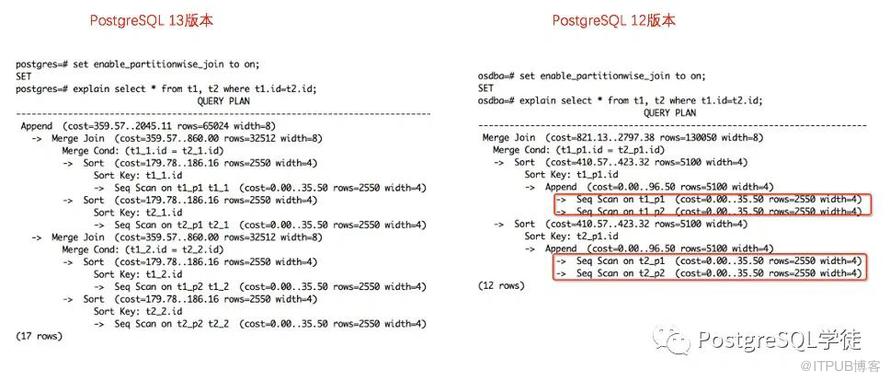
create table t1(id int) partition by range(id);
create table t1_p1 partition of t1 for values from (0) to (100);
create table t1_p2 partition of t1 for values from (150) to (200);
create table t2(id int) partition by range(id);
create table t2_p1 partition of t2 for values from (0) to (50);
create table t2_p2 partition of t2 for values from (100) to (175);
然后我们分别在PostgreSQL 12版本和PostgreSQL 13执行下面的SQL:
explain select * from t1, t2 where t1.id=t2.id;
对比如下:
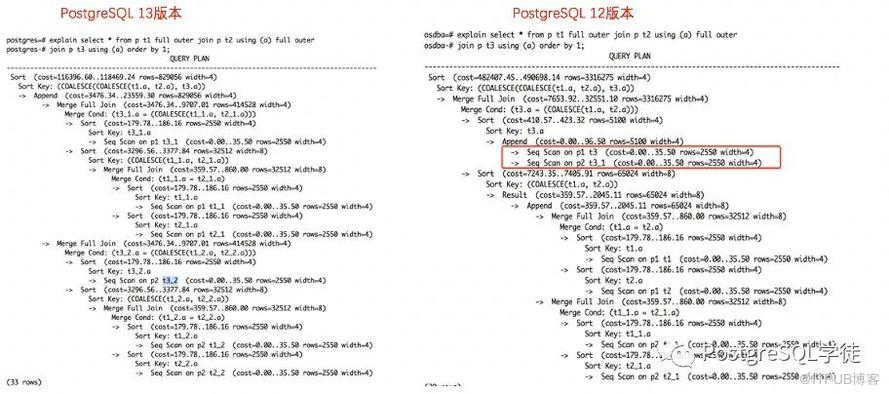
三个分区表full outer join也智能join
create table p (a int) partition by list (a);
create table p1 partition of p for values in (1);
create table p2 partition of p for values in (2);
set enable_partitionwise_join to on;
Before ROW trigger in partitioned table
在PostgreSQL 13中支持对分区表上创建before row trigger,用户尝试在PostgreSQL 12中的分区表上创建 before row trigger会报错。下面的示例表明现在可以在分区表上创建before row trigger。另外,它还表明了这样一个限制,即此类触发器不能修改该行,因为会违反其分区约束,否则可能会被重新路由到正确的分区。
PostgreSQL 12
postgres=# create or replace function trigfunc() returns trigger language plpgsql as $$ begin new.y := new.y + 1; return new; end $$;
CREATE FUNCTION
postgres=#
postgres=# create trigger brtrig before insert on foo for each row execute function trigfunc();
ERROR:  "foo" is a partitioned table
DETAIL:  Partitioned tables cannot have BEFORE / FOR EACH ROW triggers.
PostgreSQL 13
postgres=# create or replace function trigfunc() returns trigger
language plpgsql
as $$
begin
new.y := new.y + 1;
return new;
end $$;
CREATE FUNCTION
postgres=# create trigger brtrig before insert on foo for each row execute function trigfunc();
CREATE TRIGGER
The statement below shows that the trigger causes the row to move to another partition and it results in an error. The before ROW trigger function is called on partition table which causes moving the row to another partition and results in an error.

postgres=# insert into foo(y) values ('2006-02-28');
ERROR:  moving row to another partition during a BEFORE FOR EACH ROW trigger is not supported
DETAIL:  Before executing trigger "brtrig", the row was to be in partition "public.foo_p1".
Allow partitioned table to be replication via Publication
在 PostgreSQL 13之前,分区表必须单独复制。现在可以显式发布分区表,从而自动发布所有分区。从分区表中添加 / 删除分区会自动从发布中添加/删除。create publication 的选项 publish_via_partition_root 控制对分区的更改是发布它们自己的还是它们的祖先的。
“The publish_via_partition_root (boolean) parameter added to CREATE PUBLICATION determines if the changes of partition tables are replicated using their own schema or of its root partitioned table’s. The default is false meaning that the partition changes are published using their own schema. When set true, TRUNCATE operations on the individual partitions are not replicated because doing so as TRUNCATE of the root partitioned table would be wrong.
PostgreSQL 12,会报错
postgres=# create publication pub for table foo;
ERROR:  "foo" is a partitioned table
DETAIL:  Adding partitioned tables to publications is not supported.
HINT:  You can add the table partitions individually.

The publication would be created on the individual partitions :

postgres=# create publication pub for table foo_p1, foo_p2;
CREATE PUBLICATION

postgres=# \dRp+ pub
                         Publication pub
   Owner   | All tables | Inserts | Updates | Deletes | Truncates
-----------+------------+---------+---------+---------+-----------
 ahsanhadi | f          | t       | t       | t       | t
Tables:
    "public.foo_p1"
    “public.foo_p2"
PostgreSQL 13
postgres=# create publication pub_root for table foo with (publish_via_partition_root = true);
CREATE PUBLICATION

postgres=# \dRp+ pub_root
                            Publication pub_root
   Owner   | All tables | Inserts | Updates | Deletes | Truncates | Via root
-----------+------------+---------+---------+---------+-----------+----------
 ahsanhadi | f          | t       | t       | t       | t         | t
Tables:
    "public.foo"
Partition Improvements in PostgreSQL 14
PostgreSQL 14 also introduces the ability to leverage query parallelism when querying remote databases using foreign data wrappers. The PostgreSQL foreign data wrapper, postgres_fdw, added support for this in PostgreSQL 14 when the async_capable flag is set. postgres_fdw also supports bulk inserts and can import table partitions using IMPORT FOREIGN SCHEMA and can now execute TRUNCATE on foreign tables.
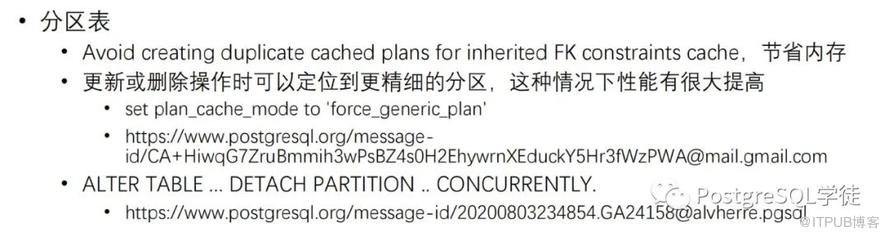
This release also has several improvements to the partitioning system, including performance gains when updating or deleting rows on tables where only a few partitions are affected. In PostgreSQL 14, partitions can now be detached in a non-blocking manner using the ALTER TABLE ... DETACH PARTITION ... CONCURRENTLY command.
PostgreSQL 14 makes numerous improvements to VACUUM, with optimizations geared towards indexes. Autovacuum now analyzes partitioned tables and can propagate information about row counts to parent tables. There are also performance gains in ANALYZE that can be controlled with maintenance_io_concurrency parameter.
The REINDEX command can now process all of the child indexes of a partitioned table, and PostgreSQL 14 adds the pg_amcheck utility to help check for data corruption.
更新和删除只涉及到少量分区表时,性能提高
Autovacuum现在analyze分区子表,并将row行统计信息反馈到父表,另外同样可以通过调整maintenance_io_concurrency异步IO参数调优。
支持非阻塞的ALTER TABLE ... DETACH PARTITION ... CONCURRENTLY
支持 reindex concurrently,如下:
=$ CREATE TABLE users (
    id int8 generated always AS IDENTITY PRIMARY KEY,
    username text NOT NULL
) partition BY range (id);
=$ CREATE INDEX q ON users (username);
=$ CREATE TABLE users_0 partition OF users FOR VALUES FROM (0) TO (10);
=$ CREATE TABLE users_1 partition OF users FOR VALUES FROM (10) TO (20);
=$ CREATE TABLE users_2 partition OF users FOR VALUES FROM (20) TO (30);
一段时间后,可能会希望重建索引,以消除膨胀。但运行reindex需要获取access exclusive lock,这会阻止对表的访问。到目前为止,我们还不能并行的重建分区索引
$ reindex (verbose) INDEX concurrently q;
ERROR:  REINDEX IS NOT yet implemented FOR partitioned indexes
当然,我们可以分别重建每个子索引
$ reindex (verbose) INDEX concurrently users_0_username_idx;
INFO:  INDEX "z.users_0_username_idx" was reindexed
DETAIL:  CPU: USER: 0.00 s, system: 0.00 s, elapsed: 0.01 s.
REINDEX

$ reindex (verbose) INDEX concurrently users_1_username_idx;
INFO:  INDEX "z.users_1_username_idx" was reindexed
DETAIL:  CPU: USER: 0.00 s, system: 0.00 s, elapsed: 0.01 s.
REINDEX

$ reindex (verbose) INDEX concurrently users_2_username_idx;
INFO:  INDEX "z.users_2_username_idx" was reindexed
DETAIL:  CPU: USER: 0.00 s, system: 0.00 s, elapsed: 0.01 s.
REINDEX
在PostgreSQL14中,可以这样:
$ reindex (verbose) INDEX concurrently q;
INFO:  INDEX "public.users_0_username_idx" was reindexed
DETAIL:  CPU: USER: 0.00 s, system: 0.00 s, elapsed: 0.02 s.
INFO:  INDEX "public.users_1_username_idx" was reindexed
DETAIL:  CPU: USER: 0.00 s, system: 0.00 s, elapsed: 0.00 s.
INFO:  INDEX "public.users_2_username_idx" was reindexed
DETAIL:  CPU: USER: 0.00 s, system: 0.00 s, elapsed: 0.00 s.
REINDEX
以下引自唐成老师钉钉分享的《PostgreSQL 14版本新特性介绍》:
目前遗留点
看样子目前PostgreSQL截至v14还是不支持Oracle的Interval分区,间隔分区是Oracle 11.1引入的新功能,通过该功能,可以在输入相应分区的数据时自动创建相应的分区。在没有间隔分区技术之前,DBA通常会创建一个maxvalue分区以避免ORA-14400:插入的分区键值不能映射到任何分区("inserted partition key does not map to any partition") 错误。https://www.postgresql.org/message-id/flat/7fec3abb-c663-c0d2-8452-a46141be6d4a%40postgrespro.ru 这个patch可以自动创建分区,但是很遗憾没有合入到主分支中,处于讨论中,并且还需要一些额外的工作。
Really nice, great work and thanks to all involved. I hope that the next steps will be:

Support automatic partition creation for range partitioning
Support automatic partition creation on the fly when data comes in, which requires a new partition. In the thread this is referenced as “dynamic” partitioning and what is implemented here is referenced as “static” partitioning
这个patch需要引入一个新的语法,详见 https://blog.dbi-services.com/postgresql-14-automatic-hash-and-list-partitioning/
CREATE TABLE tbl_list (i int) PARTITION BY LIST (i)
CONFIGURATION (values in (1, 2), (3, 4) DEFAULT PARTITION tbl_default);
另外,EDB也有Interval这个功能:https://www.enterprisedb.com/postgres-tutorials/interval-partitioning-edb-postgres-advanced-server-auto-create-new-partition。
看样子还是得pg_pathman来做或者 UDF 来做了
-
HASH and RANGE partitioning schemes;
目前支持range , hash分区
Partitioning by expression and composite key;
-
Both automatic and manual partition management;
支持自动分区管理(通过函数接口创建分区,自动将主表数据迁移到分区表),或手工分区管理(通过函数实现,将已有的表绑定到分区表,或者从分区表剥离)
-
Support for integer, floating point, date and other types, including domains;
支持的分区字段类型包括int, float, date, 以及其他常用类型,包括自定义的domain。
Effective query planning for partitioned tables (JOINs, subselects etc);
RuntimeAppend&RuntimeMergeAppendcustom plan nodes to pick partitions at runtime;PartitionFiltert drop-in replacement for INSERT triggers;PartitionRouterandPartitionOverseerfor cross-partition UPDATE queries (instead of triggers);-
Automatic partition creation for new INSERTed data (only for RANGE partitioning);
支持自动新增分区,目前仅支持range分区表。
Improved
COPY FROMstatement that is able to insert rows directly into partitions;User-defined callbacks for partition creation event handling;
Non-blocking concurrent table partitioning;
FDW support (foreign partitions);
Various GUC toggles and configurable settings.
Partial support of
declarative partitioning(from PostgreSQL 10).
UDF参照如下:
 CREATE TABLE measurement (
        city_id        int not null,
        logdate        date not null,
        peaktemp        int,
        unitsales      int
    );

  CREATE OR REPLACE FUNCTION new_partition_creator() RETURNS trigger AS
  $BODY$
    DECLARE
      partition_date TEXT;
      partition TEXT;
      partition_day int;
      startdate date;
      enddate date;
    BEGIN
      partition_day := to_char(NEW.logdate,'DD');
      partition_date := to_char(NEW.logdate,'YYYY_MM');

         IF partition_day < 15 THEN
      partition := TG_RELNAME || '_' || partition_date || '_p1';
      startdate := to_char(NEW.logdate,'YYYY-MM-01');
      enddate := date_trunc('MONTH', NEW.logdate) + INTERVAL '1 MONTH - 1 day';
      ELSE
      partition := TG_RELNAME || '_' || partition_date || '_p2';
      startdate := to_char(NEW.logdate,'YYYY-MM-15');
      enddate := date_trunc('MONTH', NEW.logdate) + INTERVAL '1 MONTH - 1 day';
      END IF;

      IF NOT EXISTS(SELECT relname FROM pg_class WHERE relname=partition) THEN
        RAISE NOTICE 'A partition has been created %',partition;
        EXECUTE 'CREATE TABLE ' || partition || ' ( CHECK ( logdate >= DATE ''' || startdate || '''  AND logdate <=  DATE ''' ||  enddate || ''' )) INHERITS (' || TG_RELNAME || ');';
        EXECUTE 'CREATE INDEX ' || partition || '_logdate ON '  || partition || '(logdate)';
        EXECUTE 'ALTER TABLE ' || partition || ' add primary key(city_id);';
        END IF;
        EXECUTE 'INSERT INTO ' || partition || ' SELECT(' || TG_RELNAME || ' ' || quote_literal(NEW) || ').* RETURNING city_id;';
      RETURN NULL;
    END;
  $BODY$
LANGUAGE plpgsql VOLATILE
COST 100;


    CREATE TRIGGER testing_partition_insert_trigger BEFORE INSERT ON measurement FOR EACH ROW EXECUTE PROCEDURE new_partition_creator();

  postgres=# insert into measurement values(1,'2017-10-11',10,10);
    NOTICE:  A partition has been created measurement_2017_10_p1
    INSERT 0 0
另外,还有一个pg_party的脚本,https://github.com/derkan/pg_party,这个脚本可以自动将新的日期范围分区添加到表中,不过仅支持时间范围类型。
Automatic partitioning script for PostgreSQL v9.1+

This single script can automatically add new date range partitions to tables automatically. Supported plans are year, month, week, day, hour.

pg_party.sh uses a tables(pg_party_config, pg_party_config_ddl) and a functions(pg_party_date_partition, pg_party_date_partition_native) to add new partitions
v10到v12的分区表演进
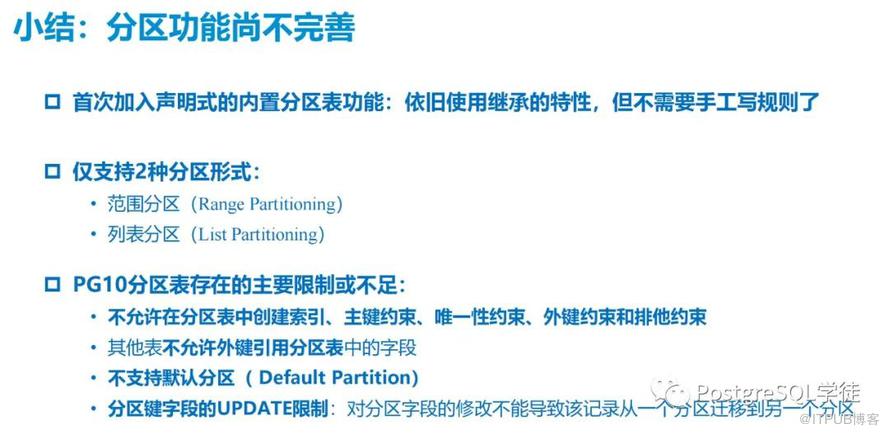
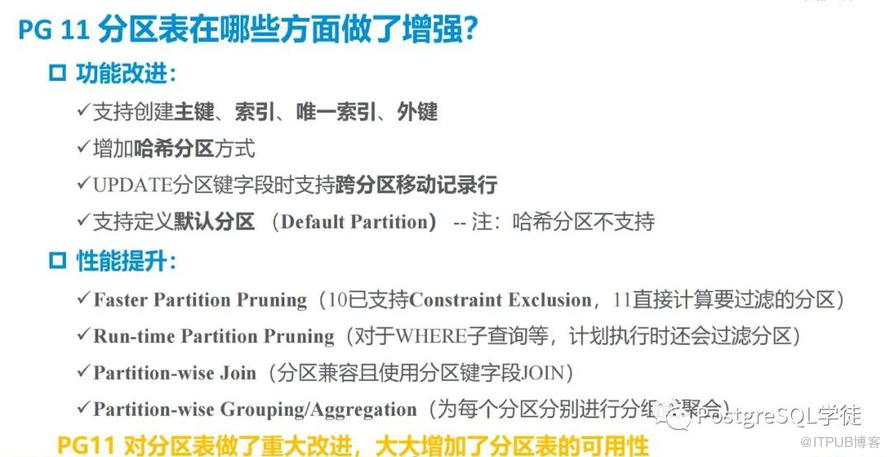
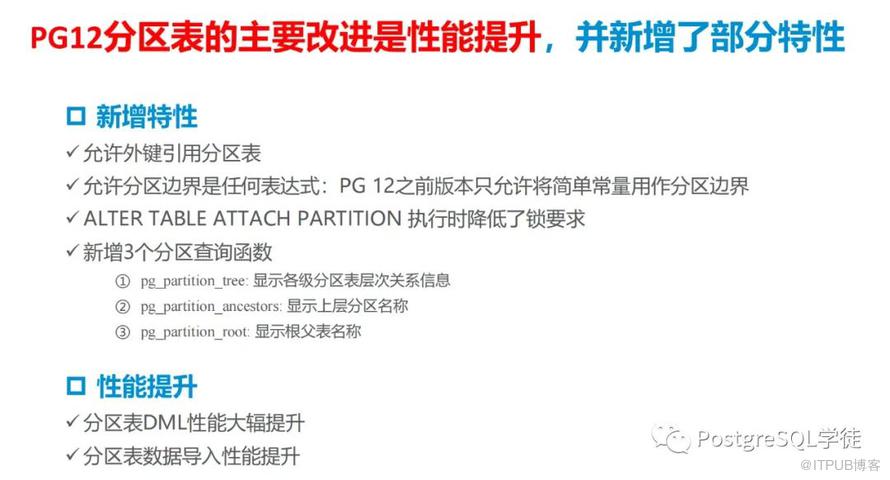
关于v10到v12的分区表演进,可以看一下陈河堆老师的 《PostgreSQL表分区功能演进》,深入浅出,十分详尽。B站就有 https://www.bilibili.com/video/BV17p4y1D7iz/,PPT的话相信很多人都有 ~ 这里直接贴一下部分结论
PostgreSQL11: 分区表增加哈希分区
PostgreSQL11:分区表支持创建主键、外键、索引、触发器
PostgreSQL11: 分区表支持UPDATE分区键,如果在分区表上创建了一个索引,PostgreSQL 自动为每个分区创建具有相同属性的索引。
PosgtreSQL 11 支持为分区表创建一个默认(DEFAULT)的分区
对于 PostgreSQL 10 中的分区表,无法创建引用其他表的外键约束。PostgreSQL 11 解决了这个限制,可以创建分区表上的外键。
在 PostgreSQL 10 中,分区上的索引需要基于各个分区手动创建,而不能基于分区的父表创建索引。PostgreSQL 11 可以基于分区表创建索引。如果在分区表上创建了一个索引,PostgreSQL 自动为每个分区创建具有相同属性的索引。
PostgreSQL 12后:ALTER TABLE ATTACH PARTITION不会阻塞查询
小结
PostgreSQL中的分区表由最开始的基于触发器/规则 + 继承的方式,到v10引入的声明式分区,再到刚刚发布的v14 beta,分区的功能可以看到越来越强,另外之前曾发现v11原生分区表的一个Bug,可以参照之前文章 《不同用户看到的执行计划居然不一样?》,不过遗憾的是,截止v14,仍未支持Oracle的Interval分区,需要自己预先创建好很多很多的分区表,这个无异于占着茅坑不拉屎,只能自己使用UDF或pg_party来实现了。在PostgreSQL 11 引入了DEFAULT分区,用来存储不满足已定义分区范围的记录行,在以前向分区表插入的记录行不在已定义分区范围内时会失败报错,这个和Oracle的max分区是类似的。
再次感谢前辈们的经验!
参考
https://www.postgresql.org/about/news/postgresql-14-beta-1-released-2213/
https://www.highgo.ca/2020/08/08/partitioning-improvements-in-postgresql-13/
https://blog.dbi-services.com/postgresql-14-automatic-hash-and-list-partitioning/
https://stackoverflow.com/questions/55642326/automatic-partitioning-by-day-postgresql
https://www.depesz.com/2020/09/08/waiting-for-postgresql-14-add-support-for-partitioned-tables-and-indexes-in-reindex/
https://github.com/derkan/pg_party
https://developer.aliyun.com/article/62314
http://www.pgsql.tech/article_0_10000102
???