不管是上学还是上班,有时不可避免需要看英文文章,特别是在写毕业论文的时候。
比较头疼的是把专业性很强的英文pdf文章翻译成中文。
我记得我上学的时候,是一段一段复制,或者碰到不认识的单词就百度翻译一下,非常耗费时间。
英文好的请绕道 。
。
本文提供批量识别pdf中英文的方法,后续文章实现自动pdf英文转中文文档,敬请期待 。
。
安装pdfplumber库
识别单个pdf的内容
2.1 识别单页的内容
2.2 识别所有页的内容
识别文件夹中所有pdf的内容

识别pdf中的内容,需要用到pdfplumber库,所以首先安装pdfplumber库,常规代码如下:
pip install pdfplumber
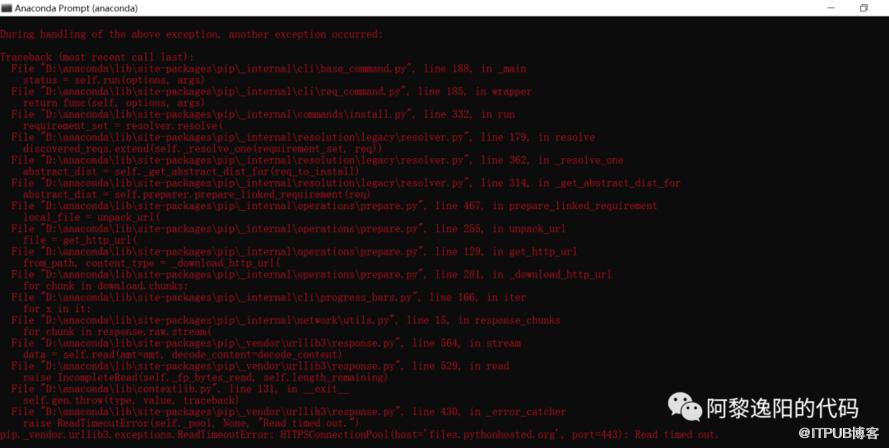
阿里云 http://mirrors.aliyun.com/pypi/simple/中国科技大学 https://pypi.mirrors.ustc.edu.cn/simple/豆瓣(douban) http://pypi.douban.com/simple/清华大学 https://pypi.tuna.tsinghua.edu.cn/simple/
pip install pdfplumber -i https://pypi.mirrors.ustc.edu.cn/simple/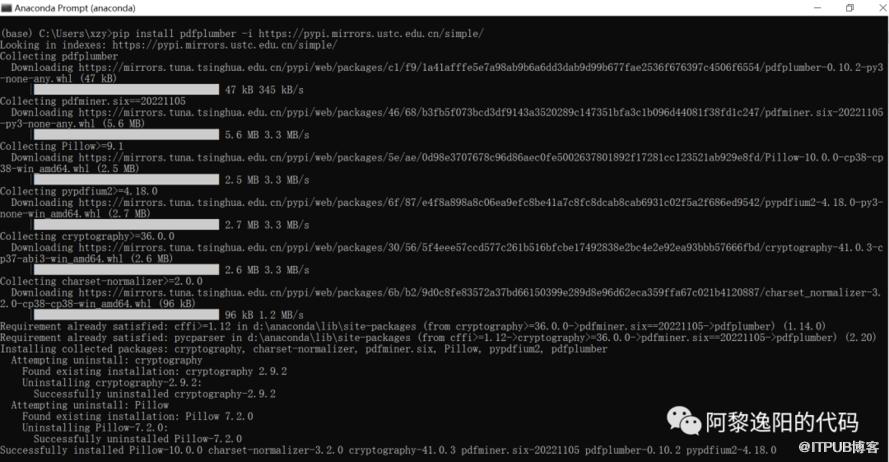

1 识别单页的内容
首先看下要识别的pdf长什么样。
然后介绍识别单页内容的代码,具体如下:
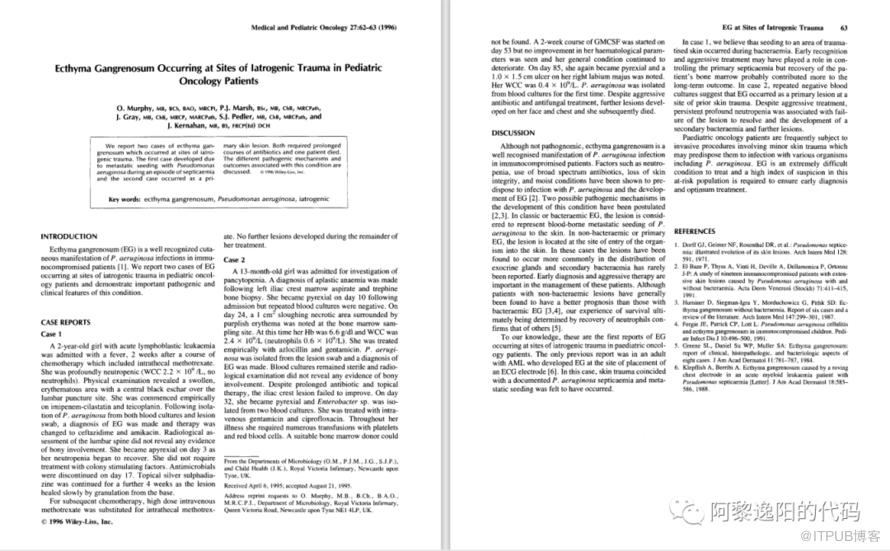
import pdfplumber as plb#识别单页的文字file_path = r'F:\公众号\74_pdf英文翻译\murphy1996.pdf'with plb.open(file_path) as pdf:page = pdf.pages[0]print(page.extract_text())file_path:存放英文pdf的路径。 pdf.pages[0]:要识别内容的页,数值0代表第一页,依次类推。 page.extract_text()):提取出页面的内容。 得到结果: Medical and Pediatric Oncology 27:62-63 (1996)Ecthyma Gangrenosum Occurring at Sites of Iatrogenic Trauma in PediatricOncology Patients0.M urphy, MB, BCh, BAO, MRCPI, P.J. Marsh, BSC, MB, ChB, MRCPath,s.1.j. Gray, MB, ChB, MRCP, MARCPath, Pedler, MB, ChB, MRCPath, andj. Kernahan, MB, BS, FRcP(Ed) DCHWe report two cases of ecthyma gan- mary skin lesion. Both required prolongedgrenosum which occurred at sites of iatro- courses of antibiotics and one patient died.genic trauma. The first case developed due The different pathogenic mechanisms andto metastatic seeding with Pseudornonas outcomes associated with this condition areaeruginosa during an episode of septicaemia discussed. 01996 Wiley-Liss, Inc.and the second case occurred as a pri-Key words: ecthyma gangrenosum, Pseudomonas aeruginosa, iatrogenicINTRODUCTION ate. No further lesions developed during the remainder ofher treatment.Ecthyma gangrenosum (EG) is a well recognized cuta-neous manifestation of P.a eruginosa infections in immu- Case 2nocompromised patients [ 11. We report two cases of EGA 13-month-old girl was admitted for investigation ofoccurring at sites of iatrogenic trauma in pediatric oncol-pancytopenia. A diagnosis of aplastic anaemia was madeogy patients and demonstrate important pathogenic andfollowing left iliac crest marrow aspirate and trephineclinical features of this condition.bone biopsy. She became pyrexial on day 10 followingadmission but repeated blood cultures were negative. Onday 24, a 1 cm2 sloughing necrotic area surrounded byCASE REPORTS purplish erythema was noted at the bone marrow Sam-pling site. At this time her Hb was 6.6 g/dl and WCC wasCase 12.4 X 10⁹/L( neutrophils 0.6 X 10⁹/L). She was treatedA 2-year-old girl with acute lymphoblastic leukaemiaempirically with azlocillin and gentamicin. P. aerugi-was admitted with a fever, 2 weeks after a course ofnma was isolated from the lesion swab and a diagnosis ofchemotherapy which included intrathecal methotrexate.EG was made. Blood cultures remained sterile and radio-She was profoundly neutropenic (WCC 2.2 X lo9 /L, no logical examination did not reveal any evidence of bonyneutrophils). Physical, examination revealed a swollen,involvement. Despite prolonged antibiotic and topicalerythematous area with a central black eschar over thetherapy, the iliac crest lesion failed to improve. On daylumbar puncture site. She was commenced empirically32, she became pyrexial and Enterobacter sp. was iso-on imipenem-cilastatin and teicoplanin. Following isola-lated from two blood cultures. She was treated with intra-tion of P. aeruginosa from both blood cultures and lesionvenous gentamicin and ciprofloxacin. Throughout herswab, a diagnosis of EG was made and therapy wasillness she required numerous transfusions with plateletschanged to ceftazidime and amikacin. Radiological as-and red blood cells. A suitable bone marrow donor couldsessment of the lumbar spine did not reveal any evidenceof bony involvement. She became apyrexial on day 3 asher neutropenia began to recover. She did not requireFrom the Departments of Microbiology (O.M., P.J.M., J.G., S .J.P.),treatment with colony stimulating factors. Antimicrobialsand Child Health (J.K.), Royal Victoria Infirmary, Newcastle uponwere discontinued on day 17. Topical silver sulphadia- Tyne, UK.zine was continued for a further 4 weeks as the lesionReceived April 6, 1995; accepted August 21, 1995healed slowly by granulation from the base.Address reprint requests to 0. Murphy, M.B., B.Ch., B.A.O.,For subsequent chemotherapy, high dose intravenousM.R.C.P.I., Department of Microbiology, Royal Victoria Infirmary,methotrexate was substituted for intrathecal methotrex- Queen Victoria Road, Newcastle upon Tyne NEl 4LP, UK.0 1996 Wiley-Liss, Inc.
可以对比pdf的第一页,结果是一致的。 2 识别所有页的内容
如果要识别pdf所有页的内容,可以用for循环实现,具体代码如下:
#识别所有页的文字with plb.open(file_path) as pdf:for page in pdf.pages:print(page.extract_text())得到结果:
Medical and Pediatric Oncology 27:62-63 (1996)Ecthyma Gangrenosum Occurring at Sites of Iatrogenic Trauma in PediatricOncology Patients0.M urphy, MB, BCh, BAO, MRCPI, P.J. Marsh, BSC, MB, ChB, MRCPath,s.1.j. Gray, MB, ChB, MRCP, MARCPath, Pedler, MB, ChB, MRCPath, andj. Kernahan, MB, BS, FRcP(Ed) DCHWe report two cases of ecthyma gan- mary skin lesion. Both required prolongedgrenosum which occurred at sites of iatro- courses of antibiotics and one patient died.genic trauma. The first case developed due The different pathogenic mechanisms andto metastatic seeding with Pseudornonas outcomes associated with this condition areaeruginosa during an episode of septicaemia discussed. 01996 Wiley-Liss, Inc.and the second case occurred as a pri-Key words: ecthyma gangrenosum, Pseudomonas aeruginosa, iatrogenicINTRODUCTION ate. No further lesions developed during the remainder ofher treatment.Ecthyma gangrenosum (EG) is a well recognized cuta-neous manifestation of P.a eruginosa infections in immu- Case 2nocompromised patients [ 11. We report two cases of EGA 13-month-old girl was admitted for investigation ofoccurring at sites of iatrogenic trauma in pediatric oncol-pancytopenia. A diagnosis of aplastic anaemia was madeogy patients and demonstrate important pathogenic andfollowing left iliac crest marrow aspirate and trephineclinical features of this condition.bone biopsy. She became pyrexial on day 10 followingadmission but repeated blood cultures were negative. Onday 24, a 1 cm2 sloughing necrotic area surrounded byCASE REPORTS purplish erythema was noted at the bone marrow Sam-pling site. At this time her Hb was 6.6 g/dl and WCC wasCase 12.4 X 10⁹/L( neutrophils 0.6 X 10⁹/L). She was treatedA 2-year-old girl with acute lymphoblastic leukaemiaempirically with azlocillin and gentamicin. P. aerugi-was admitted with a fever, 2 weeks after a course ofnma was isolated from the lesion swab and a diagnosis ofchemotherapy which included intrathecal methotrexate.EG was made. Blood cultures remained sterile and radio-She was profoundly neutropenic (WCC 2.2 X lo9 /L, no logical examination did not reveal any evidence of bonyneutrophils). Physical, examination revealed a swollen,involvement. Despite prolonged antibiotic and topicalerythematous area with a central black eschar over thetherapy, the iliac crest lesion failed to improve. On daylumbar puncture site. She was commenced empirically32, she became pyrexial and Enterobacter sp. was iso-on imipenem-cilastatin and teicoplanin. Following isola-lated from two blood cultures. She was treated with intra-tion of P. aeruginosa from both blood cultures and lesionvenous gentamicin and ciprofloxacin. Throughout herswab, a diagnosis of EG was made and therapy wasillness she required numerous transfusions with plateletschanged to ceftazidime and amikacin. Radiological as-and red blood cells. A suitable bone marrow donor couldsessment of the lumbar spine did not reveal any evidenceof bony involvement. She became apyrexial on day 3 asher neutropenia began to recover. She did not requireFrom the Departments of Microbiology (O.M., P.J.M., J.G., S .J.P.),treatment with colony stimulating factors. Antimicrobialsand Child Health (J.K.), Royal Victoria Infirmary, Newcastle uponwere discontinued on day 17. Topical silver sulphadia- Tyne, UK.zine was continued for a further 4 weeks as the lesionReceived April 6, 1995; accepted August 21, 1995healed slowly by granulation from the base.Address reprint requests to 0. Murphy, M.B., B.Ch., B.A.O.,For subsequent chemotherapy, high dose intravenousM.R.C.P.I., Department of Microbiology, Royal Victoria Infirmary,methotrexate was substituted for intrathecal methotrex- Queen Victoria Road, Newcastle upon Tyne NEl 4LP, UK.0 1996 Wiley-Liss, Inc.EG at Sites of Iatrogenic Trauma 63not be found. A 2-week course of GMCSF was started on In case 1, we believe that seeding to an area of trauma-day 53 but no improvement in her haematological param- tised skin occurred during bacteraemia. Early recognitioneters was seen and her general condition continued to and aggressive treatment may have played a role in con-deteriorate. On day 85, she again became pyrexial and a trolling the primary septicaemia but recovery of the pa-1. O X 1.5 cm ulcer on her right labium majus was noted. tient’s bone marrow probably contributed more to theHer WCC was 0.4 X 10⁹/L. P. aeruginosa was isolated long-term outcome. In case 2, repeated negative bloodfrom blood cultures for the first time. Despite aggressive cultures suggest that EG occurred as a primary lesion at aantibiotic and antifungal treatment, further lesions devel- site of prior skin trauma. Despite aggressive treatment,oped on her face and chest and she subsequently died. persistent profound neutropenia was associated with fail-ure of the lesion to resolve and the development of asecondary bacteraemia and further lesions.DISCUSSIONPaediatric oncology patients are frequently subject toAlthough not pathognomic, ecthyma gangrenosum is a invasive procedures involving minor skin trauma whichwell recognised manifestation of P. aeruginosa infection may predispose them to infection with various organismsin immunocompromised patients. Factors such as neutro- including P. aeruginosa. EG is an extremely difficultpenia, use of bread spectrum antibiotics, loss of skin condition to treat and a high index of suspicion in thisintegrity, and moist conditions have been shown to pre- at-risk population is required to ensure early diagnosisdispose to infection with P. aeruginosa and the develop- and optimum treatment.ment of EG [2]. Two possible pathogenic mechanisms inthe development of this condition have been postulated[2,3]. In classic or bacteraemic EG, the lesion is consid-ered to represent blood-borne metastatic seeding of P.aeruginosa to the skin. In non-bacteraemic or primary REFERENCESEG, the lesion is located at the site of entry of the organ-1. Dorff GJ, Geimer NF, Rosenthal DR, et al.: Pseudornonas septice-ism into the skin. In these cases the lesions have beenmia: illustrated evolution of its skin lesions. Arch Intern Med 128:found to occur more commonly in the distribution of 591, 1971.exocrine glands and secondary bacteraemia has rarely 2 El Baze P, Thyss A, Vinti H, Deville A, Dellamonica P, Ortonnebeen reported. Early diagnosis and aggressive therapy are J-P: A study of nineteen immunocompromised patients with exten-sive skin lesions caused by Pseudomonas aeruginosa with andimportant in the management of these patients. Althoughwithout bacteraemia. Acta Derm Venereol (Stockh) 71:411-415,patients with non-bacteraemic lesions have generally1991.been found to have a better prognosis than those with 3. Huminer D, Siegman-Igra Y, Morduchowicz G, Pitlik SD: Ec-bacteraemic EG [3,4], our experience of survival ulti- thyma gangrenosum without bacteraemia. Report of six cases and amately being determined by recovery of neutrophils con- review of the literature. Arch Intern Med 147:299-301, 1987.4. Fergie JE, Patrick CP, Lott L: Pseudomonas aeruginosa cellulitisfirms that of others [5].and ecthyma gangrenosum in imrnunocompromised children. Pedi-To our knowledge, these are the first reports of EG atr Infect Dis J 10:496-500, 1991.occurring at sites of iatrogenic trauma in paediatric oncol- 5. Greene SL, Daniel Su WP, Muller SA: Ecthyma gangrenosurn:ogy patients. The only previous report was in an adult report of clinical, histopathologic, and bacteriologic aspects ofwith AML who developed EG at the site of placement of eight cases. J Am Acad Dermatol 11:781-787, 1984.6. Klepflish A, Bembi A. Ecthyma gangrenosum caused by a rovingan ECG electrode [6]. In this case, skin trauma coincidedchest electrode in an acute myeloid leukaemia patient withwith a documented P. aeruginosa septicaemia and meta-Pseudomonas septicaemia [Letterl. J Am Acad Dermatol 18585-static seeding was felt to have occurred. 586, 1988.
三、识别文件夹中所有pdf的内容
最后应用循环依次打开文件夹中的文件,识别文件中每一页对应的英文。
由于是测试代码,所以只在文件夹中放了两个文件。
具体识别代码如下:
import osfolder_path = r"F:\公众号\74_pdf英文翻译\cs"#文件夹路径file_list = os.listdir(folder_path)#获取文件夹中所有文件的文件名j =1for file_name in file_list:print('===================第', j, '个文件=====================')j += 1print(file_name)#打印文件夹中的文件名file_path = folder_path + '\\' + file_namewith plb.open(file_path) as pdf:k = 1for page in pdf.pages:print(' ')print('第',k, '页')k += 1print(page.extract_text())得到结果:
===================第 1 个文件=====================murphy1996.pdf第 1 页Medical and Pediatric Oncology 27:62-63 (1996)Ecthyma Gangrenosum Occurring at Sites of Iatrogenic Trauma in PediatricOncology Patients0.M urphy, MB, BCh, BAO, MRCPI, P.J. Marsh, BSC, MB, ChB, MRCPath,s.1.j. Gray, MB, ChB, MRCP, MARCPath, Pedler, MB, ChB, MRCPath, andj. Kernahan, MB, BS, FRcP(Ed) DCHWe report two cases of ecthyma gan- mary skin lesion. Both required prolongedgrenosum which occurred at sites of iatro- courses of antibiotics and one patient died.genic trauma. The first case developed due The different pathogenic mechanisms andto metastatic seeding with Pseudornonas outcomes associated with this condition areaeruginosa during an episode of septicaemia discussed. 01996 Wiley-Liss, Inc.and the second case occurred as a pri-Key words: ecthyma gangrenosum, Pseudomonas aeruginosa, iatrogenicINTRODUCTION ate. No further lesions developed during the remainder ofher treatment.Ecthyma gangrenosum (EG) is a well recognized cuta-neous manifestation of P.a eruginosa infections in immu- Case 2nocompromised patients [ 11. We report two cases of EGA 13-month-old girl was admitted for investigation ofoccurring at sites of iatrogenic trauma in pediatric oncol-pancytopenia. A diagnosis of aplastic anaemia was madeogy patients and demonstrate important pathogenic andfollowing left iliac crest marrow aspirate and trephineclinical features of this condition.bone biopsy. She became pyrexial on day 10 followingadmission but repeated blood cultures were negative. Onday 24, a 1 cm2 sloughing necrotic area surrounded byCASE REPORTS purplish erythema was noted at the bone marrow Sam-pling site. At this time her Hb was 6.6 g/dl and WCC wasCase 12.4 X 10⁹/L( neutrophils 0.6 X 10⁹/L). She was treatedA 2-year-old girl with acute lymphoblastic leukaemiaempirically with azlocillin and gentamicin. P. aerugi-was admitted with a fever, 2 weeks after a course ofnma was isolated from the lesion swab and a diagnosis ofchemotherapy which included intrathecal methotrexate.EG was made. Blood cultures remained sterile and radio-She was profoundly neutropenic (WCC 2.2 X lo9 /L, no logical examination did not reveal any evidence of bonyneutrophils). Physical, examination revealed a swollen,involvement. Despite prolonged antibiotic and topicalerythematous area with a central black eschar over thetherapy, the iliac crest lesion failed to improve. On daylumbar puncture site. She was commenced empirically32, she became pyrexial and Enterobacter sp. was iso-on imipenem-cilastatin and teicoplanin. Following isola-lated from two blood cultures. She was treated with intra-tion of P. aeruginosa from both blood cultures and lesionvenous gentamicin and ciprofloxacin. Throughout herswab, a diagnosis of EG was made and therapy wasillness she required numerous transfusions with plateletschanged to ceftazidime and amikacin. Radiological as-and red blood cells. A suitable bone marrow donor couldsessment of the lumbar spine did not reveal any evidenceof bony involvement. She became apyrexial on day 3 asher neutropenia began to recover. She did not requireFrom the Departments of Microbiology (O.M., P.J.M., J.G., S .J.P.),treatment with colony stimulating factors. Antimicrobialsand Child Health (J.K.), Royal Victoria Infirmary, Newcastle uponwere discontinued on day 17. Topical silver sulphadia- Tyne, UK.zine was continued for a further 4 weeks as the lesionReceived April 6, 1995; accepted August 21, 1995healed slowly by granulation from the base.Address reprint requests to 0. Murphy, M.B., B.Ch., B.A.O.,For subsequent chemotherapy, high dose intravenousM.R.C.P.I., Department of Microbiology, Royal Victoria Infirmary,methotrexate was substituted for intrathecal methotrex- Queen Victoria Road, Newcastle upon Tyne NEl 4LP, UK.0 1996 Wiley-Liss, Inc.第 2 页EG at Sites of Iatrogenic Trauma 63not be found. A 2-week course of GMCSF was started on In case 1, we believe that seeding to an area of trauma-day 53 but no improvement in her haematological param- tised skin occurred during bacteraemia. Early recognitioneters was seen and her general condition continued to and aggressive treatment may have played a role in con-deteriorate. On day 85, she again became pyrexial and a trolling the primary septicaemia but recovery of the pa-1. O X 1.5 cm ulcer on her right labium majus was noted. tient’s bone marrow probably contributed more to theHer WCC was 0.4 X 10⁹/L. P. aeruginosa was isolated long-term outcome. In case 2, repeated negative bloodfrom blood cultures for the first time. Despite aggressive cultures suggest that EG occurred as a primary lesion at aantibiotic and antifungal treatment, further lesions devel- site of prior skin trauma. Despite aggressive treatment,oped on her face and chest and she subsequently died. persistent profound neutropenia was associated with fail-ure of the lesion to resolve and the development of asecondary bacteraemia and further lesions.DISCUSSIONPaediatric oncology patients are frequently subject toAlthough not pathognomic, ecthyma gangrenosum is a invasive procedures involving minor skin trauma whichwell recognised manifestation of P. aeruginosa infection may predispose them to infection with various organismsin immunocompromised patients. Factors such as neutro- including P. aeruginosa. EG is an extremely difficultpenia, use of bread spectrum antibiotics, loss of skin condition to treat and a high index of suspicion in thisintegrity, and moist conditions have been shown to pre- at-risk population is required to ensure early diagnosisdispose to infection with P. aeruginosa and the develop- and optimum treatment.ment of EG [2]. Two possible pathogenic mechanisms inthe development of this condition have been postulated[2,3]. In classic or bacteraemic EG, the lesion is consid-ered to represent blood-borne metastatic seeding of P.aeruginosa to the skin. In non-bacteraemic or primary REFERENCESEG, the lesion is located at the site of entry of the organ-1. Dorff GJ, Geimer NF, Rosenthal DR, et al.: Pseudornonas septice-ism into the skin. In these cases the lesions have beenmia: illustrated evolution of its skin lesions. Arch Intern Med 128:found to occur more commonly in the distribution of 591, 1971.exocrine glands and secondary bacteraemia has rarely 2 El Baze P, Thyss A, Vinti H, Deville A, Dellamonica P, Ortonnebeen reported. Early diagnosis and aggressive therapy are J-P: A study of nineteen immunocompromised patients with exten-sive skin lesions caused by Pseudomonas aeruginosa with andimportant in the management of these patients. Althoughwithout bacteraemia. Acta Derm Venereol (Stockh) 71:411-415,patients with non-bacteraemic lesions have generally1991.been found to have a better prognosis than those with 3. Huminer D, Siegman-Igra Y, Morduchowicz G, Pitlik SD: Ec-bacteraemic EG [3,4], our experience of survival ulti- thyma gangrenosum without bacteraemia. Report of six cases and amately being determined by recovery of neutrophils con- review of the literature. Arch Intern Med 147:299-301, 1987.4. Fergie JE, Patrick CP, Lott L: Pseudomonas aeruginosa cellulitisfirms that of others [5].and ecthyma gangrenosum in imrnunocompromised children. Pedi-To our knowledge, these are the first reports of EG atr Infect Dis J 10:496-500, 1991.occurring at sites of iatrogenic trauma in paediatric oncol- 5. Greene SL, Daniel Su WP, Muller SA: Ecthyma gangrenosurn:ogy patients. The only previous report was in an adult report of clinical, histopathologic, and bacteriologic aspects ofwith AML who developed EG at the site of placement of eight cases. J Am Acad Dermatol 11:781-787, 1984.6. Klepflish A, Bembi A. Ecthyma gangrenosum caused by a rovingan ECG electrode [6]. In this case, skin trauma coincidedchest electrode in an acute myeloid leukaemia patient withwith a documented P. aeruginosa septicaemia and meta-Pseudomonas septicaemia [Letterl. J Am Acad Dermatol 18585-static seeding was felt to have occurred. 586, 1988.===================第 2 个文件=====================zori1998.pdf第 1 页American Journal of Medical Genetics 80:399–402 (1998)Germline PTEN Mutation in a FamilyWith Cowden Syndrome andBannayan-Riley-Ruvalcaba SyndromeRobertoT.Zori,1* DebbieJ.Marsh,2 GailE.Graham,3 ErrolB.Marliss,4 and CharisEng2,51DivisionofGenetics,DepartmentofPediatrics,UniversityofFlorida,Gainesville,Florida2TranslationalResearchLaboratory,CharlesA.DanaHumanCancerGeneticsUnit,DepartmentofAdultOncology,Dana-FarberCancerInstitute,DepartmentofMedicine,HarvardMedicalSchool,Boston,Massachusetts3DepartmentofMedicalGenetics,UniversityofCalgary,Calgary,Alberta,Canada4McGillNutritionandFoodScienceCentre,FacultyofMedicine,McGillUniversity,Montreal,Quebec,Canada5CancerResearchCampaign,HumanCancerGeneticsResearchGroup,UniversityofCambridge,Cambridge,UnitedKingdomClinical overlap between Cowden disease nayan-Riley-Ruvalcaba (BRR) syndrome [Cohen,and Bannayan-Riley-Ruvalcaba syndrome 1990]. Clinical overlap with Cowden disease has nothas rarely been described and identical been well described in the literature; however, identi-germline mutations in the PTEN gene have cal germline mutations in the PTEN gene have beenbeen demonstrated in a few families with demonstrated in some families with Cowden diseaseCowden disease and some cases of Ban- [Liaw et al., 1997] as well as rare cases of BRR syn-nayan-Riley-Ruvalcaba syndrome. We re- drome [Marsh et al., 1998]. We report on a germlineportonamotherwithCowdendiseaseanda PTENmutationinafamilyconsistingofayoungmanson with Bannayan-Riley-Ruvalcaba syn- with BRR syndrome and his mother with Cowden dis-drome. Mutation analysis of the PTEN gene ease, perhaps suggesting that Cowden disease anddemonstratedaheterozygousnonsensemu- BRR syndrome are manifestations of the same singletationR130Xinbothindividuals.Thismight gene disorder.suggestthatCowdendiseaseandBannayan-Riley-Ruvalcaba syndrome are one causalCLINICAL REPORTentity. Am. J. Med. Genet. 80:399–402, 1998.©1998Wiley-Liss,Inc. This18-year-oldmanwasinitiallyseeninthegenet-icsclinicatage11yearsforseveredevelopmentaldelayKEY WORDS: Cowden disease; Bannayan- and autistic behavior. He was born after a pregnancyRiley-Ruvalcaba syndrome; complicatedbymaternalthyroidadenomaat16weeksPTEN;thyroidcancer;polyp- of gestation. The adenoma was treated by partial thy-osis; Bannayan-Zonana syn- roidectomy followed by thyroid supplementation. Indrome; Ruvalcaba-Myhre the last trimester, the mother had toxemia and thesyndrome child was born at term by forceps delivery. The amni-oticfluidwasmeconiumstainedbuttherewerenoneo-natalcomplications.Birthweightwas3.43kg.HehadINTRODUCTION diarrheafrequentlyandoccasionalvomitingininfancy;although he was switched from cow to soy milk at 5Thereissignificantclinicaloverlapbetweenthephe- months,nolactoseallergyorintolerancecouldbedem-notypes described as Ruvalcaba-Myhre-Smith syn- onstrated. In early childhood, he developed melenadrome, Bannayan-Zonana syndrome, and Riley-Smith that resolved after removal of a few rectal polyps, andsyndrome to warrant unification under the term Ban- the pathology report showed benign pseudopolyp withtelagiectatic vessels in an inflammed myxoid stroma.Facialandpedalmaculeswereremoved.Thehistologi-calreportdescribedtheleftfootmaculeasaveryearlyContract grant sponsor: Raymond C. Philips Research andjunctional nevus, the right foot macule as a dysplasticEducationContract,Children’sMedicalServices,Departmentofjunctional nevus, and the right cheek macule as anChildrenandFamilies,StateofFlorida.intradermalnevuswithfeaturesofacongenitalnevus*Correspondenceto:RobertoT.Zori,M.D.,DepartmentofPe-diatrics, P.O. Box 100296, JHMHC, University of Florida, and focal superficial atypia. He also had surgery forGainesville,FL32606.E-mail:ZORIRT@Peds.ufl.edu inguinal hernias. He had some truncal hypotonia thatReceived30April1998;Accepted23June1998 resolved,buthefirstwalkedat2years,startedsaying© 1998 Wiley-Liss, Inc.第 2 页400 Zorietal.single words at 2 years, and two-to-three-word sen-tencesat5.HisverbalandperformanceIQswere40at11years.Magneticresonanceimageofthehead,nerveconduction studies, and electroencephalogram werenormal. He had extensive neurological and metabolicstudies. Results of a muscle biopsy were normal aswere those of urine organic acids and quantitative se-rum amino acids. He had no acidosis although he hashadinconsistentlymildlyelevatedlactatelevels.Alac-tatetopyruvateratioinfibroblastswasatthelowendof the normal range and pyruvate oxidation in fibro-blastswasreducedtoabout50%ofnormal.Themusclebiopsyshowednormalpyruvatedehydrogenase(PDH)complex activity and the PDH complex activity inyoungfibroblastswasjustunderthenormalrange,andin older passage cells, the activity was low. A bloodkaryotypeincludinghighresolutionforchromosomeXand 10 was normal. He occasionally had uncharacter-isticshort‘‘spells’’butdefiniteseizureactivitywasnot Fig.2. MotherwithCowdendiseaseshowingoralregionandtongue.documented. He developed a goiter at 18 years forwhich he had a left hemithyroidectomy, and a tumorwasalsoexcisedfromtherightside.Theleftlobecon- had thyroid surgery for a large adenoma and was ontainedaninsular(follicular)carcinomawhiletheright thyroid supplementation. She had polyposis of the en-showed nodular hyperplasia with a focus of papillary tire gastrointestinal canal. A mammogram showed bi-microcarcinoma. lateral fibroglandular tissue with single well-definedHis family history is remarkable in that his mother benign nodules in each side with mild dysplasia. An(Fig. 1) also has a large head (59 1⁄ cm) and has mul- abdominal ultrasound study demonstrated stones bi-2tiplesmallpapulesonhertongueandmouth(Fig.2).A laterallythatweretreatedbylithotrypsyandahepaticdentist had informed her, based on clinical findings, subscapular hemangioma measuring 1.4 cm in diam-that she had Cowden syndrome. A biopsy from one of eter. A computed tomographic scan of the abdomenthe papules showed irregular acanthosis with pseudo- demonstratedalargelipomaintheleftiliopsoasarea.epitheliomatoushyperplasiaandchronicinflammation She also had fibromata of the uterus. The father wasofsubmucosa.Abiopsyreportfromapapuleoftheleft healthy with no medical problems. His physical find-foot showed focal acanthosis and hyperkeratosis. She ingswerenormalexceptforaheadcircumferenceof601⁄ 2cm.Abrotherandsisterweredevelopmentallynor-mal.Theyhadnohyperpigmentedlesionsandnomedi-cal problems. A maternal grandfather had metastaticthyroid cancer and died of leukemia. A brother of thematernal grandfather died of colon cancer at age 70years. The maternal grandmother had a gastric lym-phomaandalargeheadbyreportandhermotherhadthyroid surgery in her forties.Onphysicalexaminationatage11years,thepatienthadaheadsizethatwas59cmandnormalheightandweight.Hisjawappearedlargebuttherewerenootheranomalies (Fig. 3). His tongue appeared normal andthere were no tumors or oral mucocutaneous anoma-lies.Hehadtwodarklypigmentedlesionsonthesolesofhisfeetandtwoonhisface.Hehadmultiplehyper-pigmentedmaculesontheglansandshaftofhispenis(Fig. 4) , with otherwise normal genitalia. He had nohypotonia but a slight tremor and apparently de-creasedattentionspanwithprominentuseofonewordcommunicationandperseverations.Helackedthesec-ondtoes.Therestofthephysicalexamwasunremark-able.Atage18years,hisconditionwasunchangedbuthehaddevelopedafewmoremaculesonhisfacewhilethe original macules had grown.Becauseupto80%ofclassicCowdensyndromefami-liesandapproximately50%ofBRRfamiliesandcaseshave been found to have germline PTEN mutation[Marshetal.,1998]wedecidedtodeterminethePTENFig.1. MotherwithCowdendisease. status in this family segregating both Cowden syn-第 3 页PTENMutation 401Fig.3. IndexpatientwithBRRsyndrome.Fig.4. GenitaliaofindexpatientwithBRRsyndromeshowingirregu-larpigmentarychanges.dromeandBRR.GenomicDNAwasextractedfrompe-ripheral blood leukocytes of the propositus and hismother. Using three independent mutation detection manifesting either as BRR syndrome or Cowden dis-methods, denaturing gradient gel electrophoresis ease.ThissuggeststhatCowdendiseaseandBRRsyn-(DGGE), temporal temperature gel electrophoresis drome should be considered as one entity. The ex-(TTGE), and direct sequencing [Marsh et al., 1998; tremely variable interfamiliar and intrafamiliar ex-Marsh et al., in press], revealed a mutation within pression has to be explained by genetic or epigeneticexon5ofthegene.BoththemotherwithCowdensyn- modification. The aggravation of findings in subse-dromeandhersonwithBRRwereshowntoharborthis quent generations seen in this family confirms a priorgermline nonsense mutation at codon 130, R130X, reportthatsuggestsanticipation[Starinketal.,1986].whichlieswithinthephosphatasecoremotif.Asecond Imprinting is also implicated since transmissionphlebotomy from the mother was performed for pur- throughfemalesappearstoleadtomoresevereexpres-posesofreconfirmingthemutation,andagaintheger- sion whereas transmission through males does notmline PTEN mutation R130X was demonstrated. seem to affect severity [Hanssen et al., 1993].DISCUSSION ACKNOWLEDGMENTSThisyoungmanhaspenilelentigines,macrocephaly,Supported in part by the Raymond C. Philips Re-learning disabilities, hamartomatous gastrointestinalsearch and Education Contract, Children’s Medicalpolyps, and thyroid disease, findings consistent withServices, Department of Children and Families, StateBRRsyndrome.Themotherhasmucocutanouslesions,ofFlorida.Wethankthefamilywhoparticipatedinthegastrointestinal polyps, a thyroid tumor, a lipoma, fi-study,andLarryComptonforeditorialassistance.Webroids,andmacrocephaly,thefindingsofCowdensyn-thank Dr. Peter Chauvin, Dental Pathology, McGilldrome[Cohen,1990].Furthermore,themother’sclini-University,Dr.ManonAuger,SurgicalPathology,Mc-cal features make the International Cowden Consor-Gill University, and Dr. Brian Robinson, Departmenttium diagnostic criteria for Cowden syndrome [Eng,of Genetics, Hospital for Sick Children, Toronto, for1997].ThegermlinePTENmutation,R130X,foundintheir data.thisfamilywithbothCowdensyndromeandBRRhavebeenpreviouslydescribedinatleastthreefamilieswithREFERENCESclassicCowdensyndrome[Marshetal.,1998;Nelenetal.,1997].ThatR130Xsegregatesinthisfamily,there-CohenMM(1990):Bannayan-Riley-Ruvalcabasyndrome:Renamingthreefore,appearstohaveanautosomaldominantcondition syndromesasoneetiologicentity.AmJMedGenet35:291.第 4 页402 Zorietal.EngC(1997):Cowdensyndrome.JGenetCounsel6:181–191. LongyM,EngC(1998):Mutationspectrumandgenotype-phenotypeHanssenAMN,WerquinH,SuysE,FrynsJP(1993):Cowdensyndrome: analyses in Cowden disease and Bannayan-Zonana syndrome, twoReportofalargefamilywithmacrocephalyandincreasedseverityof hamartoma syndromes with germline PTEN mutation. Hum Molsignsinsubsequentgenerations.ClinGenet44:281–286. Genet7:507–515.LiawD,MarshDJ,LiJ,DahiaPLM,WangSI,ZhengZ,BoseS,CallKM, MarshDJ,DahiaPLM,CaronS,KumJB,FraylingIM,TomlinsonIPM,TsouHC,PeacockeM,EngC,ParsonsR(1997):Germlinemutationsof HughesKS,HodgsonSV,MurdayVA,HoulstonR,EngC(inpress):the PTEN gene in Cowden disease, an inherited breast and thyroid GermlinePTENmutationsinCowdensyndrome-likefamiles.JMedcancersyndrome.NatGenet16:64–67. Genet.MarshDJ,DahiaPLM,ZhengZ,LiawD,ParsonsR,GorlinRJ,EngC NelenMR,PadbergGW,PeetersEAJ,LinAY,vandenHelmB,FrantsRR,(1997):GermlinemutationsinPTENarepresentinBannayan-Zonana CoulonV,GoldsteinAM,vanReenMMM,EastonDF,EelesRA,Hodg-syndrome.NatGenet16:333–334. sonS,MulivhillJJ,MurdayVA,TuckerMA,MarimanECM,StarinkTM, Ponder BAJ, Ropers HH, Kremer H, Longy M, Eng C (1996):MarshDJ,CoulonV,LunettaKL,Rocca-SerraP,DahiaPLM,ZhengZ,LocalizationofthegeneforCowdendiseaseto10q22-23.NatGenetLiawD,CaronS,DuboueB,LinAY,RichardsonAL,BonnetblancJM,13:114–116.BressiuxJM,Cabarrot-MorreauA,ChompretA,DemangeL,EelesRA,YahandaAM,FearonER,FrickerJP,GorlinRJ,HodgsonSV,HusonS, StarinkTM,vanderVeenJPW,ArwertF,deWaalLP,deLangeGG,GilleLacombe D, LePrat F, Odent S, Toulouse C, Olopade OI, Sobol H, JJP,ErikssonAW(1986):TheCowdensyndrome:AclinicalandgeneticTishlerS,WoodsCG,RobinsonBG,WeberHC,ParsonsR,PeacockeM, studyin21patients.ClinGenet29:222–233.至此,Python批量识别pdf中英文的方法已讲解完毕,需要的朋友可以自己跟着代码尝试一遍
。


【限时免费进群】群内提供学习Python、玩转Python、风控建模、人工智能、数据分析相关招聘内推信息、优秀文章、学习视频,也可交流学习工作中遇到的相关问题。需要的朋友添加微信号19967879837,加时备注想进的群,比如风控建模。
https://www.cnblogs.com/ybbybb/p/14328003.htmlhttps://blog.csdn.net/weixin_50746407/article/details/132419727?utm_medium=distribute.pc_relevant.none-task-blog-2~default~baidujs_baidulandingword~default-0-132419727-blog-131492090.235^v38^pc_relevant_sort_base3&spm=1001.2101.3001.4242.1&utm_relevant_index=1
一文囊括风控模型搭建(原理+Python实现),持续更新。。。


限时免费加群
19967879837
添加微信号、手机号